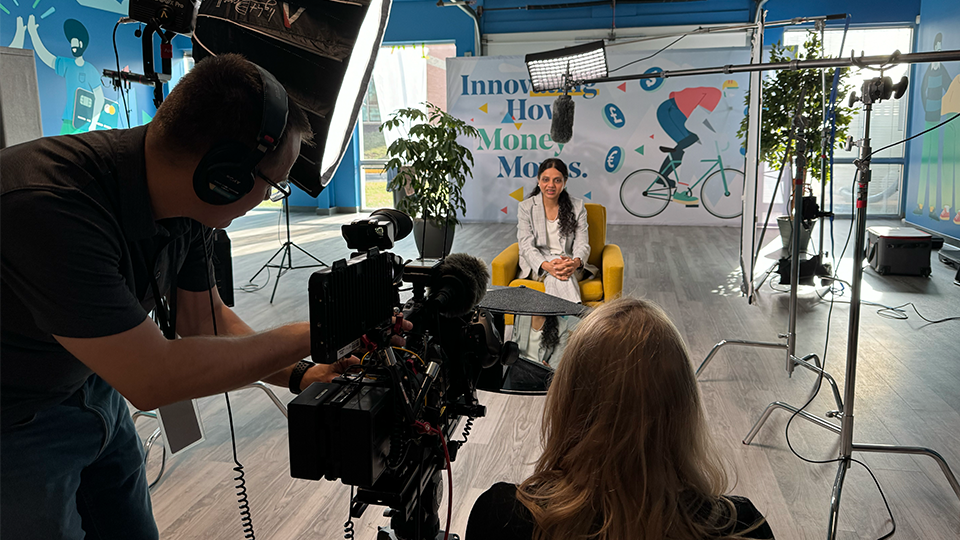
Big Button’s Simon Crofts travelled to Copenhagen in May to speak at the TwentyThree Video Summit about the realities of building a global customer advocacy video programme.
It’s a subject that sounds like it should be about cameras, editing, and production. Those things matter, of course, but they weren’t the most interesting part of the discussion. Yet few have built a programme capable of consistently producing high-quality customer advocacy content across different countries, teams and markets, while demonstrating a clear return on investment.
The further customer advocacy moves from being an occasional project to becoming an established part of the marketing mix, the more the conversation shifts away from filmmaking and towards process, planning and coordination.
Here are some of the observations Simon shared during the session.
What changes when customer advocacy becomes a programme?
Most organisations can produce a good customer story when the circumstances are right: the customer is enthusiastic, the timing works, the budget is available and everyone involved can focus their attention on a single project.
The dynamics change when customer advocacy becomes a programme. Now there are multiple customers, multiple stakeholders, competing priorities and a constant expectation for fresh content. Different regions want stories, different teams have their own requirements and new opportunities emerge with little notice.
The question is no longer whether the organisation can create a good customer story; it’s whether it can continue producing them consistently, over an extended period of time, without the quality slipping or the process becoming difficult to manage. That shift is often underestimated.
How do I coordinate a global video programme?
The finished film is the visible part of the process, but what sits behind it is often far more complicated.
Global video programmes mean stakeholders are spread across different countries, customers have busy schedules, and internal approval processes vary from market to market. Content may also need to be adapted for different audiences or translated into different languages, and regional teams often have different priorities and deadlines. None of this is especially glamorous, but it has a significant influence on the outcome.
The organisations that make global customer advocacy look effortless rarely rely on improvisation. More often, they’ve invested time in building processes that allow projects to move forward smoothly, even when multiple teams and stakeholders are involved.
Why does consistency matter to customers?
Most conversations about consistency focus on the audience. Does the content feel connected? Does it reflect the brand correctly? Does it meet the expected standard?
Customer advocacy introduces another consideration.
A customer who agrees to participate in a case study will often see other customer stories produced by the same organisation. If one story feels polished and carefully produced while another feels rushed or noticeably lower quality, the comparison is inevitable.
It’s easy to think about consistency as a branding issue. In practice, it’s also a relationship issue. Every customer who agrees to take part should feel they’ve received the same level of attention and care as every other customer featured in the programme.
As advocacy programmes grow, maintaining that consistency becomes increasingly important. You should work with an agency you can rely on to ensure a consistent output and just as importantly, a consistent experience for your customers.
Why are video playbooks important?
Few people get excited about documentation, yet many of the organisations running successful global advocacy programmes have invested considerable effort in creating clear guidance around how video should be planned, produced and distributed.
The reason is simple: in large organisations, video is often being created by different teams, in different regions and sometimes with different agency partners. Without some shared understanding of how things should work, inconsistencies begin to appear surprisingly quickly.
Good playbooks don’t exist to restrict creativity, instead, they exist to remove ambiguity. They help people understand how content should be commissioned, what standards are expected, which formats are required and how different pieces of content fit into a broader strategy.
The larger the programme becomes, the more valuable that clarity tends to be. Your agency should be able to help you with a video playbook.
How do I make my video content stand out?
Most organisations want their content to stand out, yet many end up making similar, often safe, choices. This is understandable: the safest option is often the easiest option. But obvious locations and familiar formats risk leading to predictable stories and content that feels unlikely to upset anyone.
The difficulty is that these decisions rarely happen in isolation. When enough organisations make similar choices, content starts to look and feel remarkably alike. The customer stories people tend to remember often have something distinctive about them. Sometimes that’s the customer, sometimes it’s the environment, and sometimes it’s the way the story is told.
What they usually have in common is that somebody was prepared to move beyond the safest available option. Remember to be brave and use data to justify your approach.
Why do objectives matter more than key messages?
Many video projects begin with a discussion about key messages. There’s nothing wrong with that, but it can sometimes lead organisations towards the wrong starting point.
Before deciding what a video should say, it’s worth understanding what it needs to achieve. The answer might be lead generation, sales enablement, customer retention, awareness building or supporting a specific campaign.
Once that objective is understood, creative decisions become easier. Decisions about format, duration, distribution and measurement all become easier too. The same principle applies after publication. It’s difficult to judge success if nobody agreed what success was supposed to look like before production began.
Does global have to mean identical?
One of the more interesting tensions within global programmes is the balance between consistency and flexibility.
Most organisations want content to feel connected across different regions and markets. At the same time, audiences, cultures and expectations differ.
The strongest programmes, therefore, tend to establish a framework rather than a template. They provide enough consistency that content feels recognisably part of the same programme, while still allowing regional teams to adapt stories to suit their audiences. The result feels coherent without becoming formulaic.
Do video views matter?
Video performance is often discussed in terms of views because they’re visible and easy to measure. The challenge is that business impact doesn’t always follow the same pattern.
A customer story viewed by a relatively small number of highly relevant prospects may create more commercial value than a film watched by thousands of people with little interest in the subject.
As customer advocacy programmes mature, measurement increasingly aligns with business outcomes. Attention shifts towards engagement, sales conversations, pipeline influence and revenue contribution rather than audience size alone. That doesn’t make views irrelevant; it simply places them in a wider context.
Closing thought
Looking back across the discussion in Copenhagen, what stands out is how little of it was about filming.
There was plenty of talk about customer stories, creativity and content, but many of the biggest challenges sit elsewhere: planning, coordination, consistency and processes. These are the things that rarely appear in the finished film but have a huge influence on whether the programme succeeds.
The filming is the part everybody sees. The systems behind it receive far less attention, despite having an enormous influence on whether a programme succeeds or struggles. The organisations producing customer advocacy content, across multiple markets to a consistently high standard over long periods of time, are the ones who understand that distinction particularly well.
Learn more about our video advocacy work here.